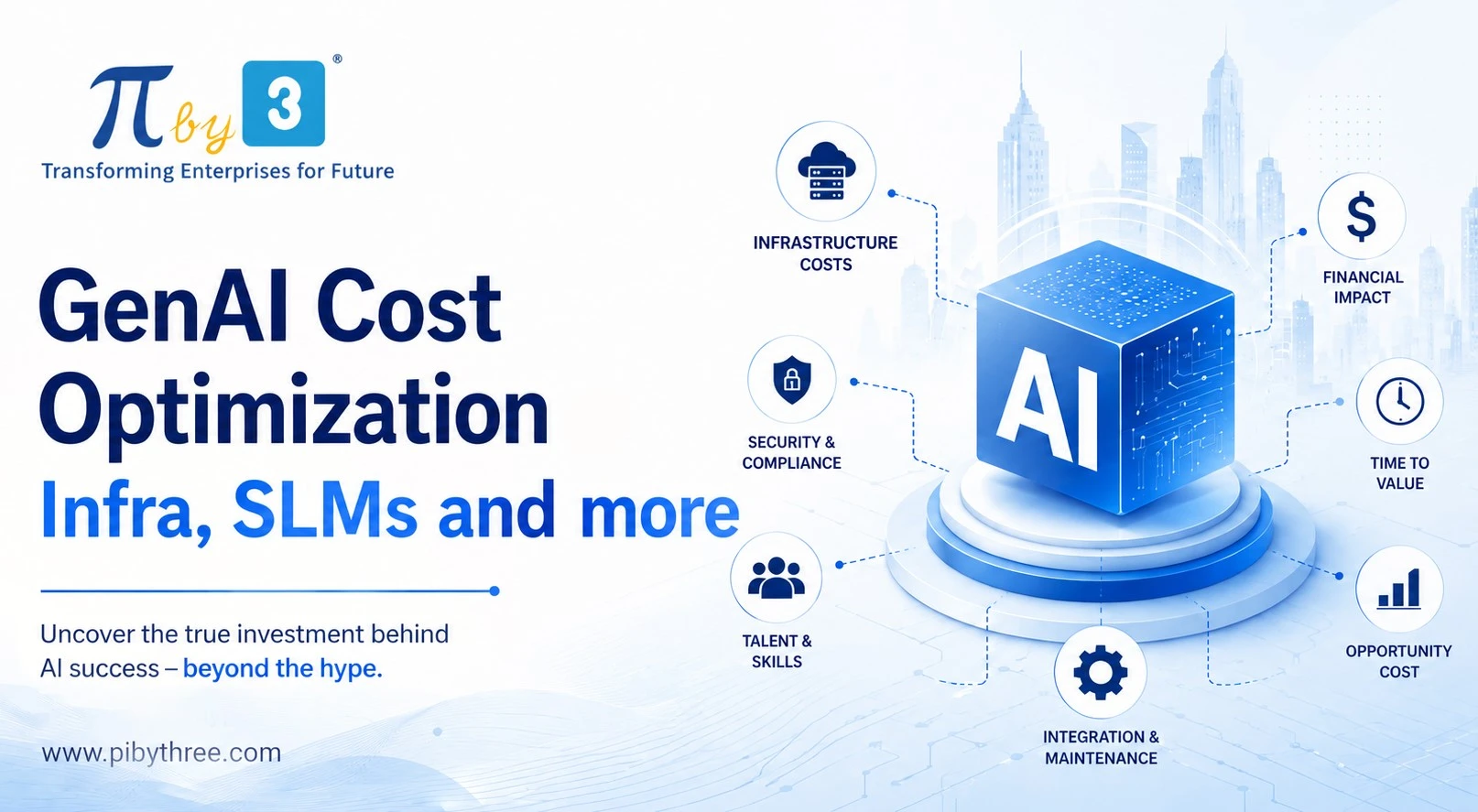
Every boardroom in 2026 has the same slide. AI investment. Big number. Bold arrow pointing up.
And yet, a June 2025 McKinsey study found that nearly 80% of companies using generative AI reported no significant impact on earnings. Gartner confirms global IT spending crosses $6.15 trillion this year with AI infrastructure alone adding $401 billion in new spend.
The money is moving. The results, for most enterprises, are not. This is not an AI problem. It is a FinOps problem.
Spending on AI without a FinOps strategy is like filling a leaking tank faster and faster, with less and less to show.
Where the AI budget actually disappears
Most enterprises invest in AI tooling first copilots, assistants, GenAI APIs and discover too late that they have no FinOps framework to govern what it costs or what it returns. According to Gartner, over 90% of AI use cases remain stuck in pilot mode not because the technology failed, but because the data and cost infrastructure feeding it was never built to scale.
AWS and Azure have built the highways. But without FinOps discipline, you're paying for the highway whether you're moving or parked.
Three patterns consistently drain AI ROI before it materialises:
1. AI spend without FinOps governance: AI workloads scale fast and so do the bills. Without FinOps accountability baked into your cloud operating model, spend grows faster than value. Gartner projects enterprises will spend over $37 billion on AI-optimised infrastructure-as-a-service by 2026. Very few have a FinOps practice mature enough to measure what comes back.
2. Data that exists but isn't trusted: Data pipelines built for reporting were never designed for real-time AI inference. Clean, structured, auditable data the kind that Snowflake, Databricks, and Azure Data Factory are optimised to handle is the non-negotiable prerequisite. Without it, your AI spend is generating noise, not insight.
3. AI features without AI architecture: Gartner calls 2026 the "trough of disillusionment" for GenAI. Enterprises are realising that embedding AI features into existing software is not the same as building AI-ready systems. A mature FinOps practice connects cloud cost decisions directly to business outcomes and most enterprises haven't made that connection yet.
What FinOps-mature enterprises do differently
The enterprises actually seeing ROI from AI share three traits. They treat cloud cost as a business metric, not an IT line item. They run FinOps reviews alongside AI roadmap reviews not after the invoice arrives. And they choose platform-neutral partners who optimise for outcomes, not vendor lock-in.
McKinsey's research makes it clear: the highest-value AI deployments are vertical and function-specific. Those deployments require clean, governed, cost-optimised cloud infrastructure the exact output of a mature FinOps practice.
The gap between AI investment and AI returns is, at its core, a FinOps maturity gap.
The right sequence matters
Build your FinOps foundation. Govern your cloud spend. Then deploy AI on infrastructure that can hold its weight and prove its worth. At PiByThree, FinOps is a core practice not an afterthought. We help enterprises across AWS, Azure, Snowflake, and Databricks cut cloud waste by up to 35% and build the cost-governed infrastructure that makes AI transformation financially sustainable.
Founded by ex-Accenture leaders, we do the high-impact work that turns AI budgets into AI results.
The AI budget is already moving in your organisation.
The question is whether your FinOps practice is ready to prove the return.
👉 Start your FinOps assessment: pibythree.com