There's a pattern we see often in enterprise AI right now. The deployment happened fast. The model is in production. And nobody can tell you, with any confidence, what it's doing or why.
That's not a hypothetical. It's the default state for most enterprise AI in 2025.
The gap nobody's talking about loudly enough
Enterprises have moved quickly from pilot to production in months, in some cases weeks. The deployment capability matured faster than the governance infrastructure around it.
The result: AI agents that handle transactions, answer customers, manage IT queues, and inform decisions with limited ability to trace their reasoning, detect when they've drifted, or explain their outputs to an auditor.
Most agents still operate as opaque systems, creating hidden risks across security, compliance, performance, and governance.
The failure mode isn't always dramatic. It's rarely a full system outage. More often, it's a model that's partially correct in ways that look entirely right confident output, wrong conclusion propagated across hundreds of transactions before anyone catches it.
Monitoring ≠ Observability
Most enterprises have monitoring. Very few have observability. These are not the same thing.
Monitoring tells you if something broke. Observability tells you why it behaved the way it did and flags the conditions that will cause it to behave that way again.
Traditional monitoring detects issues after they occur. AI observability goes further identifying patterns in performance data and predicting potential failures before they surface as incidents.
For AI specifically, this distinction is sharpest around drift. Models don't fail like servers. They degrade gradually as data distributions shift, as edge cases accumulate, as prompts evolve in ways nobody formally approved. None of that triggers a conventional alert. All of it creates material risk.
The market has moved. Governance is following
This isn't a niche concern. The observability market is expected to grow 15% from 2022 to 2027, per Gartner, with enterprises relying on it for productivity, revenue, and organizational transformation.
The acquisitions tell the same story. Cisco's $28 billion purchase of Splunk in 2024 and Snowflake's announced intent to acquire Observe in January 2026 citing AI-assisted troubleshooting and real-time context as core requirements signal that observability has shifted from infrastructure-team concern to boardroom-level investment.
On the governance side, the direction is equally clear. AI governance roles grew 17% in 2025. The share of businesses with no responsible AI policy fell from 24% to 11%. NIST's AI Risk Management Framework explicitly calls out model reliability monitoring and human oversight as non-negotiable requirements.
If your AI cannot be audited, it cannot be trusted at scale.
What "good" requires
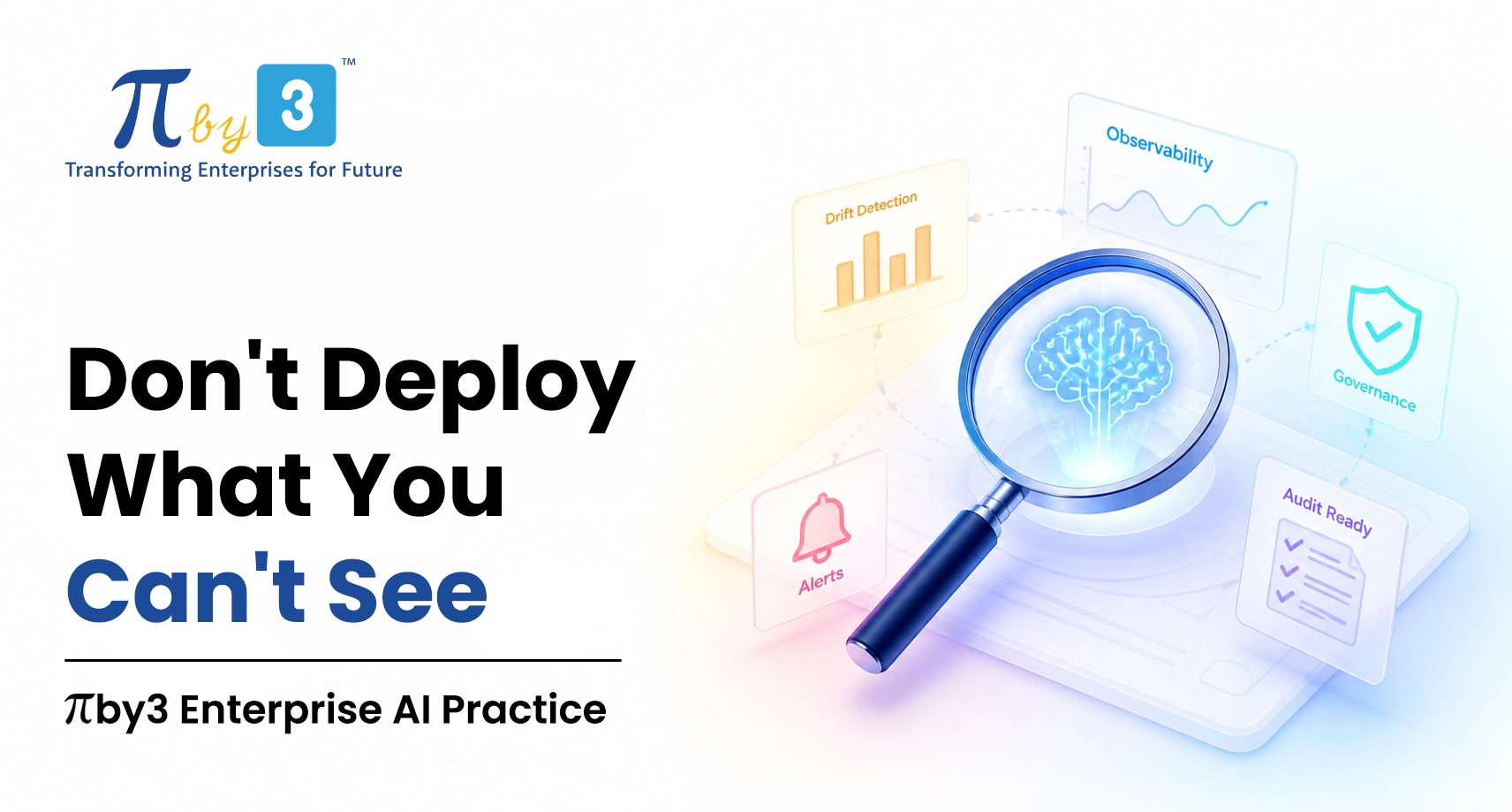
Production-grade AI observability isn't one tool. It's four capabilities working together: full reasoning traceability (every decision logged, not just outputs), automated drift detection, proactive anomaly alerting before failures surface, and audit-ready output governance tied to policy metadata.
Without AI observability, there's no way to audit what happened, why it happened, or how to prevent it from happening again.
The πby3 view
Visibility is not a feature you add after deployment. It is a precondition for it.
The enterprises that will scale AI responsibly aren't the ones who moved fastest. They're the ones who built the instrumentation to know at any moment exactly what their AI is doing and why.